What did Google publish about AI answer sources?
Alongside its new Search ranking hub, announced on November 24, 2026, Google published a Search Central page called "Attribution and factuality in Search generative AI features." It explains how AI Overviews and AI Mode choose the web pages they link to, what checks run before an AI answer is shown, and what site owners can do when an answer gets their content wrong.
The key sentence for business owners: these features use "a customized Gemini model integrated directly with Google's core web ranking, information retrieval, and quality systems." In other words, Google says its AI answers are built on the same search index and ranking signals as regular results, not on a separate system.
How does Google pick the sources its AI answers cite?
Google describes four steps:
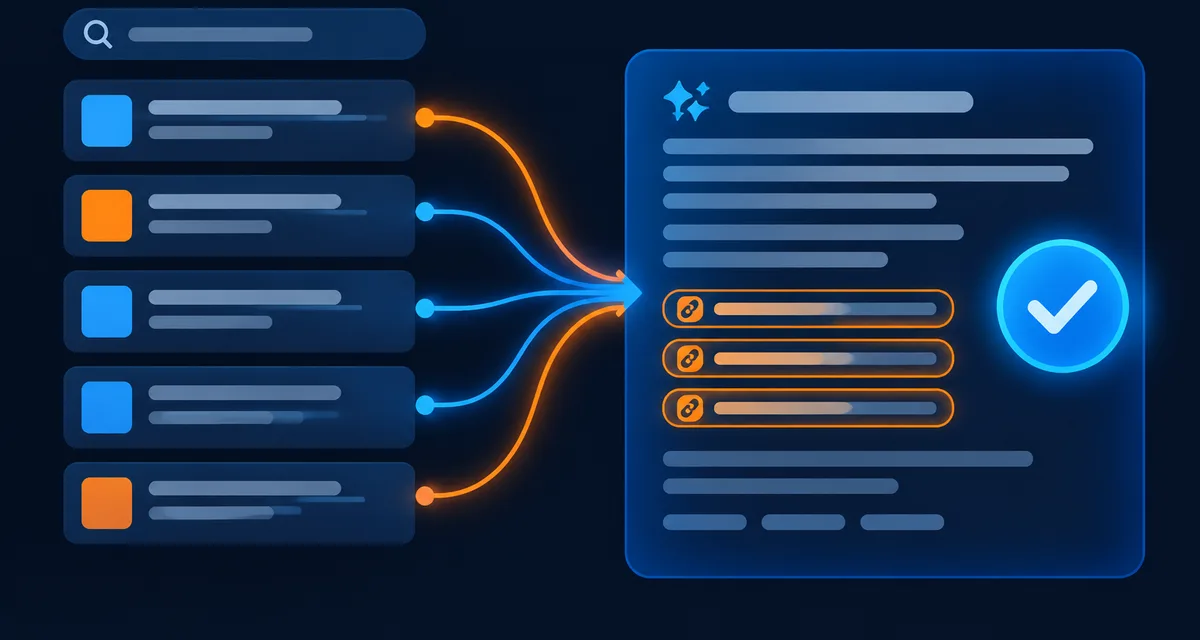
- Results from the Search index. For AI Overviews, Google first looks at the ranked results for the search and checks they are relevant. Snippets from those pages are given to the model as the basis for the answer.
- Related searches. The model may run extra searches, which Google calls "query fan-out," to find pages that cover different parts of the question.
- Grounding and corroboration. The model writes the answer from those results, then cites and links the pages that support what it says.
- Display. Google decides which supporting links to show, and how, by balancing relevance and quality signals from Search ranking with a clear layout and a diverse set of sources.
So a page that is not indexed, or that does not rank for the searches around a customer's question, has little chance of being linked in an AI answer. Pages that answer one specific part of a question clearly can also be found through those related searches.
What checks happen before an AI answer is shown?
Google says two automated checks run first. Safety and policy guardrails hold back an AI answer when it could be risky, break Search policies or lack reliable consensus, for example on sensitive "Your Money or Your Life" topics or breaking news with little coverage. A corroboration check tests the answer's claims against web results, data feeds and Google's Knowledge Graph.
Google also says it runs automated grounding checks before and after model updates, benchmark tests, live A/B tests with human evaluators, and reviews of user feedback. When it finds errors, it may limit when AI answers appear, give more weight to authoritative pages, or remove answers that break its policies.
What can you do if Google's AI gets your content wrong?
Google's page lists a fix for each situation:
- The link or credit is wrong. Use the Feedback link directly below the AI answer in Google Search.
- Your own page is unclear or out of date. Update the page. Google picks up the change the next time it crawls, and you can ask it to recrawl. If it is urgent, the Removals tool hides the page from all of Google Search for about six months while you fix it.
- Another site gets credit for your content. If you syndicate content, ask partners to block indexing of their copies. If someone copied it without permission, you may be able to file a DMCA request.
- Part of a page should not be quoted. The
nosnippet,data-nosnippetandmax-snippetcontrols limit which text can appear in Search, including in AI features.
For wider steps when an AI tool describes your business incorrectly, see what if AI gets your business wrong?
What else changed in Google Search this week?
The November 2026 core update finished rolling out on November 24, after starting on November 10, according to Google's Search Status Dashboard. The same day, Google preannounced a December 2026 core update focused on understanding longer, more complex questions and improving personalized results for people who have personalization turned on. Google has not given a start date beyond December.
Google's core update guidance recommends waiting at least a full week after an update finishes before analyzing Search Console data, then comparing against a week before the rollout began. Verified site owners can now also send feedback on a specific update in Search Console using the update's hashtag, such as #NovemberCoreUpdate2026. Google says that feedback is reviewed in aggregate to find systemic issues and does not lead to manual ranking changes for individual sites. Our guide to reading your November search data covers the earlier changes this month.
What should a business owner do now?
Because Google ties AI answers to its core ranking systems, its advice is the same practice that helps in regular Search. Google lists these steps:
- Make sure your key pages are eligible. Only pages that are indexed and can be shown with a snippet can be linked in AI answers. Check that important pages are not blocked by
noindex,nosnippetor crawl settings. - Put important facts in text. Services, prices, service areas, hours and policies should be written on the page, not only in images or PDFs.
- Show who is behind the content. Google suggests clear sourcing and background about the author or the business, such as author pages or an About page.
- Keep information accurate and current. Fix errors when things change, and avoid changing a page's date unless the content has substantially changed.
- Check how you appear. Search the questions customers ask, review the AI Overviews and AI Mode answers that link to you, and use the Generative AI performance report in Search Console. Our guide to testing your AI visibility shows how to record results consistently.
- Wait before reacting to the core update. Give it a full week of data, compare like-for-like weeks, and plan for more movement when the December update arrives.
How DigitalOS can help
DigitalOS helps business owners understand whether Google's AI Overviews, AI Mode and other AI assistants can find, trust and cite their website. We check that your key pages are eligible, map the questions and related searches your customers use, and fix the content and business facts that keep you out of AI answers. Learn more about our AI Visibility & AEO work, or start with the DigitalOS AI visibility check to see where your business stands today.
Sources and limitations
Reviewed November 25, 2026. This article summarizes Google's own documentation and status dashboard; Google does not publish exactly how any individual AI answer chooses its links, and the December 2026 core update had no confirmed start date at the time of writing. The recommendations are DigitalOS's practical reading of Google's guidance, not guaranteed outcomes.
- Google Search Central — Attribution and factuality in Search generative AI features
How AI Overviews and AI Mode select, ground and display supporting links; pre-display checks; ongoing evaluation; best practices and troubleshooting.
- Search Engine Land — "Google releases new search ranking transparency hub" (November 24, 2026)
The new Search ranking hub, update-specific feedback, preannounced updates and new AI documentation.
- Google Search Status Dashboard — November 2026 core update
Released November 10, 2026; rollout complete November 24, 2026.
- Google Search Status Dashboard — December 2026 core update (preannounced)
Focus on longer, more complex questions and personalized results; scheduled for December 2026.
- Google Search Central — Submit feedback about ranking changes in Google Search
Hashtag-tagged feedback in Search Console; reviewed in aggregate, no manual adjustments for individual URLs.
- Google Search Central — Google Search's core updates
Wait at least a full week after an update completes before comparing Search Console data.
- Search Engine Roundtable — "Google Explains How Links Are Selected & Shown In AI Overviews & AI Mode"
Independent coverage of the new attribution document.