Why can your AI visibility change overnight?
Because the AI assistants your customers use can change which sources they read and cite without announcing it. Google publicly names its core updates. AI companies also ship new models and search changes, but they rarely say how those changes affect which websites get cited. A business can do nothing wrong and still appear less often after an update, or more often.
New research shows how large these shifts can be. Muck Rack's Generative Pulse team published its October 2026 "What Is AI Reading?" report on October 28, drawing on more than 40 million AI responses and 207 million citations from 2026. It found that journalism's share of ChatGPT's citations fell from 28.1% in January to 22% in September, with sharp drops in the spring and July. Several major publishers dropped to near zero in ChatGPT citations, even though most still allowed OpenAI's search crawler and other AI providers continued to cite them.
Are new AI model launches behind these shifts?
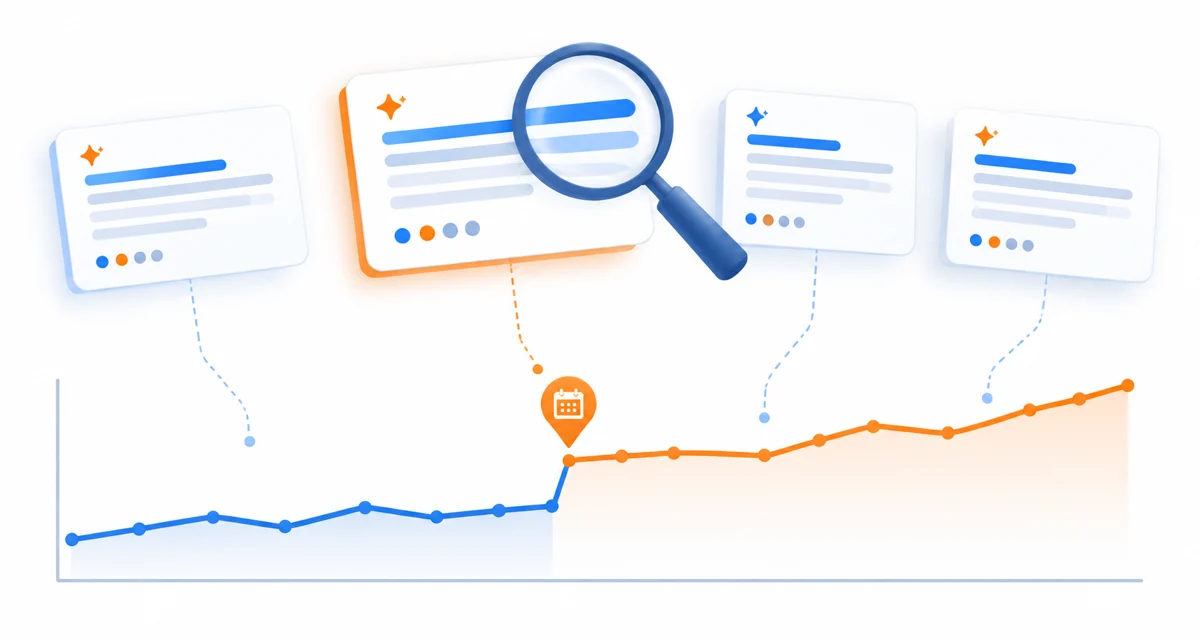
Sometimes, it appears, but nobody has confirmed it. In a November 16, 2026 Search Engine Land analysis, Anna Crowe lined up the dates of those drops with OpenAI's launch calendar. She reported that ChatGPT's citations of five major news outlets fell by 50% to 90% within a week of OpenAI rolling out a new model family on July 9, while those outlets' Google rankings stayed broadly stable and Gemini kept citing them. She also found drops in January and June that matched no launch.
Read this as a pattern worth watching, not a proven cause. The author discloses that she works at Muck Rack, which produces the research, and Generative Pulse queries AI models through their APIs, not the apps your customers use. OpenAI has not explained the changes.
The timing matters this week. On November 17, 2026, OpenAI released GPT-6.2 Astra and GPT-6.2 Sol. OpenAI's help documentation says they are available in ChatGPT Work, Codex and the API, not among the models people pick in regular ChatGPT chat. So this launch may not change everyday consumer answers directly, but apps and assistants built on OpenAI's API can move to the new models, and future launches in regular ChatGPT can reshuffle citations again.
Why does one AI answer not tell you much?
Because AI answers vary even when nothing has changed. The same report found that when the same prompt was run twice in one day, ChatGPT repeated just 41% of its cited domains and Gemini 45%, compared with 94% for Perplexity. It also found that only 212 domains were cited by all four AI providers it tracked: ChatGPT, Claude, Gemini and Perplexity.
That means a single screenshot, or one "AI visibility score" averaged across every assistant, can hide what is really happening. Track each assistant separately, and repeat the same questions over time.
How should you test AI answers after an update?
Ask the same real customer questions before and after, in a clean session, and log the results by assistant and date. A practical routine:
- Keep a fixed question list. Use 10 to 20 questions your customers actually ask, such as "best family dentist near [your city]." Our guide on how to know if AI is recommending your business shows how to set one up.
- Remove personalization in Google AI Mode. On November 17, 2026, Google introduced temporary threads in AI Mode. Google says a temporary thread is completely detached from your account, so its answers are not informed by your past preferences or saved to your history. That gives you a cleaner view of what a new customer might see. The feature is rolling out globally on desktop and mobile browsers.
- Record the sources, not just your name. Note which websites each answer cites. If you disappear, check whether the sites that used to mention you disappeared too.
- Mark launch dates on the same timeline. Note AI model launches and Google updates next to your results so you do not blame your website for a change made somewhere else.
- Repeat several times. Because answers vary from run to run, judge the pattern across several runs and several weeks, not one result.
What should you do if your AI visibility drops?
Rule out outside causes before you rewrite your website. The Search Engine Land analysis suggests checking four things: the news cycle, AI launch dates, Google updates and your own recent site changes. Only if none of them explains the drop should you look at your content.
Then check access. OpenAI documents two user agents to look for in your server logs: OAI-SearchBot, which surfaces websites in ChatGPT's search features, and ChatGPT-User, which visits pages when someone asks ChatGPT a question. If they still visit but you are cited less, that points to a change in how sources are selected, not a blocked crawler. Our guide to AI search access versus training permission explains the settings.
The longer-term protection is not depending on one type of source. The report found that more than 84% of AI citations came from earned and third-party sources such as journalism, encyclopedic, government, academic and other companies' content, while owned media, meaning brands' own websites, rose from 13.7% to 15.2%. If all your AI mentions come from one kind of source, one model change can cut them. A clear, accurate website, genuine reviews, consistent listings and relevant third-party mentions give AI more than one route to you. See how links and brand mentions support discovery.
Is there a standard way to measure AI search yet?
Not yet. On November 10, 2026, a group led by AirOps and including Paramark, Chime and Google Meridian co-founder Hitesh Wadhwani announced the AI Search Measurement Standard, an open effort to connect AI search exposure to revenue. Its first component, "AI Search Impressions," is a proposed unit for measuring AI search exposure, and the group says the standard is still being created.
Until it matures, connect AI visibility to outcomes you can count yourself: calls, form fills, bookings and sales. Our article do AI search citations bring customers? explains how to separate mentions, clicks and real inquiries.
How DigitalOS can help
DigitalOS helps businesses get found, described accurately and chosen in AI search. We can set up a repeatable test of the questions your customers ask across ChatGPT, Google AI Mode and other assistants, track which sources each one cites, and separate changes caused by AI updates from problems you can fix on your own site and listings. Learn more about our AI Visibility & AEO work, or start with the DigitalOS AI diagnostic to see where your business stands today.
Sources and limitations
Reviewed November 18, 2026. The link between ChatGPT citation drops and model launches is one analyst's reading of the timing, not confirmed by OpenAI; Generative Pulse data comes from API queries, not consumer apps, and its publisher employs the analyst. AI citation behavior changes often. This is general information. External findings are not DigitalOS experiments or guarantees.
- Muck Rack via GlobeNewswire — "Generative Pulse: Earned Media Still Drives More Than 84% of AI Citations" (October 28, 2026)
Report scope, journalism's falling share of ChatGPT citations, owned and third-party shares, answer repeatability and the 212 shared domains.
- Search Engine Land — "ChatGPT citation drops look like unannounced Google core updates" (November 16, 2026)
Comparison of citation drops with OpenAI launch dates and Google rankings; four-cause checklist; author disclosure.
- OpenAI — "Introducing GPT-6.2 Astra and Sol" (November 17, 2026)
The new models and where they are available.
- ChatGPT Learn — "GPT-6.2" (November 17, 2026)
Availability in ChatGPT Work, Codex and the API, and how they relate to models in regular Chat.
- Google — "Temporary threads are now available in AI Mode in Search" (November 17, 2026)
How temporary threads detach a session from your account and history; rollout.
- OpenAI — "Overview of OpenAI Crawlers"
OAI-SearchBot and ChatGPT-User user agents and what each does.
- AI Search Measurement Standard — "Introducing the AI Search Measurement Standard" (November 10, 2026)
Who is behind the proposed standard and its first component, AI Search Impressions.